
Blog Post 24: Three American Marches
🎶For Clarinet Quintet 🎶
Thanks for stopping by, and welcome to my blog! I hope you are having a great July so far, and Happy Independence Day! This week, I will discuss the inspiration behind one of CMP’s latest arrangements: Three American Marches, for clarinet quintet. This new CMP Collection includes Edwin E. Bagley’s iconic “National Emblem,” Henry Fillmore’s exhilarating “The Circus Bee,” and John Philip Sousa’s patriotic favorite “The Washington Post.”
By the way, have you performed any of our CMP arrangements? If so, we would greatly appreciate it if you could leave a review. Click here to leave a review/comment on my CMP YouTube Channel. If you have posted a YouTube video of a CMP arrangement, do not forget to tag us on your channel, and we will tag you back. Thanks so much! Happy practicing!
Music Trivia Questions
Before we continue, here are three music trivia questions to challenge you; I will reveal the answers towards the end of this blog post. I hope you enjoy them.
🎶First, which of these three American composers performed with the Boston Symphony Orchestra?
🎶Second, which of these three American composers wrote under several pseudonyms, including Gus Beans, Harold Bennett, Ray Hall, Harry Hartley, Al Hayes, Will Huff, and Henrietta Moore?
🎶Third, which popular dance propelled John Philip Sousa’s “The Washington Post March” to international fame when it replaced the waltz as the most popular dance form of its day in the 1890s?
Tell me your answers in the comments below, or feel free to share any other interesting information you might know about these three subjects. Now, let’s continue with the topic at hand.
Happy Independence Day, America!
After a short family visit for the holidays, we are back, hard at work, creating new exceptional arrangements for you. But first…
What does this holiday mean to you? Do you have any memorable July 4th stories to share? How do you and your family celebrate America’s Independence Day? If you are a musician, do you have a favorite Independence Day gig you fondly remember? Tell us about it in the comment section at the end of this blog post.
Three American Marches
One of CMP’s latest arrangements is a collection of three patriotic American marches for clarinet quintet. This intermediate digital download collection includes:
🎶Edwin E. Bagley's iconic "National Emblem March"
🎶Henry Fillmore's exhilarating "The Circus Bee"
🎶John Philip Sousa's classic American march, "The Washington Post"
These three iconic marches are perfect for recitals, contests, competitions, patriotic concerts, Americana events, pops concerts, or background dinner music gigs. They are short, engaging pieces that can break up a long program and give the ears a brief hiatus from some of the heavier pieces on the program.
National Emblem March: This favorite American march, written in 1902, brings back fond memories for many who remember it from “Miracle on 34th Street” and other films in which it appeared. Edwin E. Bagley’s iconic march has become synonymous with patriotic music, military ceremonies, and Americana celebrations. Although scored for only five clarinets, this arrangement sounds full and complete and will help you and your audiences celebrate our country during your patriotic events.
The Circus Bee: This exhilarating circus march, or “screamer,” written in 1908, is an excellent opener, closer, or encore for recitals and perfect for contests, competitions, weddings, special events, patriotic or Americana events, and educational outreach performances. The arrangement challenges groups ranging from college quintets to professional ensembles. Written by American composer Henry Fillmore, this march draws on ragtime influences and quickstep marches, featuring syncopated rhythms and striking dynamic contrasts.
The Washington Post: This patriotic march, named after the venerable American newspaper, is a perennial favorite and will evoke memories of favorite American pastimes with your audiences. This classic, upbeat piece, written by John Philip Sousa in 1889 in 6/8 time, became an international hit because it was the perfect tempo for the newly introduced "two-step" dance craze. It was first premiered at the Smithsonian in Washington, D.C., for President Benjamin Harrison.
These three arrangements were written for professional, college, and advanced high school ensembles. I have included an alternate Bb clarinet part in lieu of the missing Eb clarinet, and an alternate Bb clarinet part in lieu of the missing alto clarinet for all three pieces. Originally scored for a full concert band, your audiences will love these unique settings for clarinet quintet of three iconic American marches.

U.S. Air Force Band of the Golden West performing at Temple City, CA on July 4th
Performing American Music around the world


In case you missed my last blog post, here is a special section in honor of our nation’s 250th birthday! What you see above are four images from my travels in the U.S. and Europe while serving with the U.S. Air Force Bands. These are four places around the world where I have performed a great deal of American music. The first eight years of my Air Force Band career were spent with the U.S. Air Force Band of Liberty (now deactivated) at Hanscom Air Force Base, MA. Every summer, we would perform a series of local concerts we would call “out-and-backs,” where we played outdoor summer pops/patriotic concerts around New England. We would also go on summer concert tours of those states: Connecticut, Maine, Massachusetts, New Hampshire, New York, Rhode Island, and Vermont. One of my fond memories of July 4th gigs at that assignment was a local performance we did in Danvers, MA (first picture), when our clarinet section performed Leroy Anderson’s perennial favorite “Clarinet Candy.” As a clarinetist, I found it a treat for our band to feature our incredible clarinet section at a concert. It was a great gig. New England audiences always gave us a great reception. They loved hearing American classics, from Anderson to Sousa, and Gershwin to Copland.
My next assignment was with the United States Air Forces in Europe (USAFE) Band at Sembach Air Base, Germany. Each year, all seven of our small ensembles would cover two countries each over the 4th of July week, if our budget allowed. That way, we are supporting as many US Embassies as we can in one year with their July 4th festivities outside the United States. While stationed in Germany, I performed the U.S. National Anthem in Azerbaijan, Ireland, Russia, Slovakia, Turkey, and Ukraine. The second picture is from our July 4th gig in Kyiv, Ukraine; it was very memorable. We performed, as usual, at the U.S. Ambassador’s residence, this time in Kyiv. There were over a thousand people in attendance, including both Americans and Ukrainians, as well as other visiting VIPs from nearby countries. Their faces lit up when they heard the opening notes of the Star-Spangled Banner. Some of them teared up as well. Our anthem has extra special meaning when you are stationed far away from your family and friends back in America.
My third assignment was with the U.S. Air Force Band of the Golden West, located at Travis Air Force Base, in northern CA. Our band members were fortunate there because both the Los Angeles Philharmonic and the San Francisco Symphony regularly performed with us at our July 4th concerts. In the third picture, you see us performing with the Los Angeles Philharmonic at the famed Hollywood Bowl on July 4th, for a crowd of over 20,000, under the baton of maestro John Morris Russell. It was a treat to perform with this world-class orchestra; we played the “March” from Gustav Holst’s Suite No. 1 for Band in Eb, Morton Gould’s American Salute, and finished with John Philip Sousa’s Washington Post and The Stars and Stripes Forever. Great memories, a great gig, and a great way to serve your country.
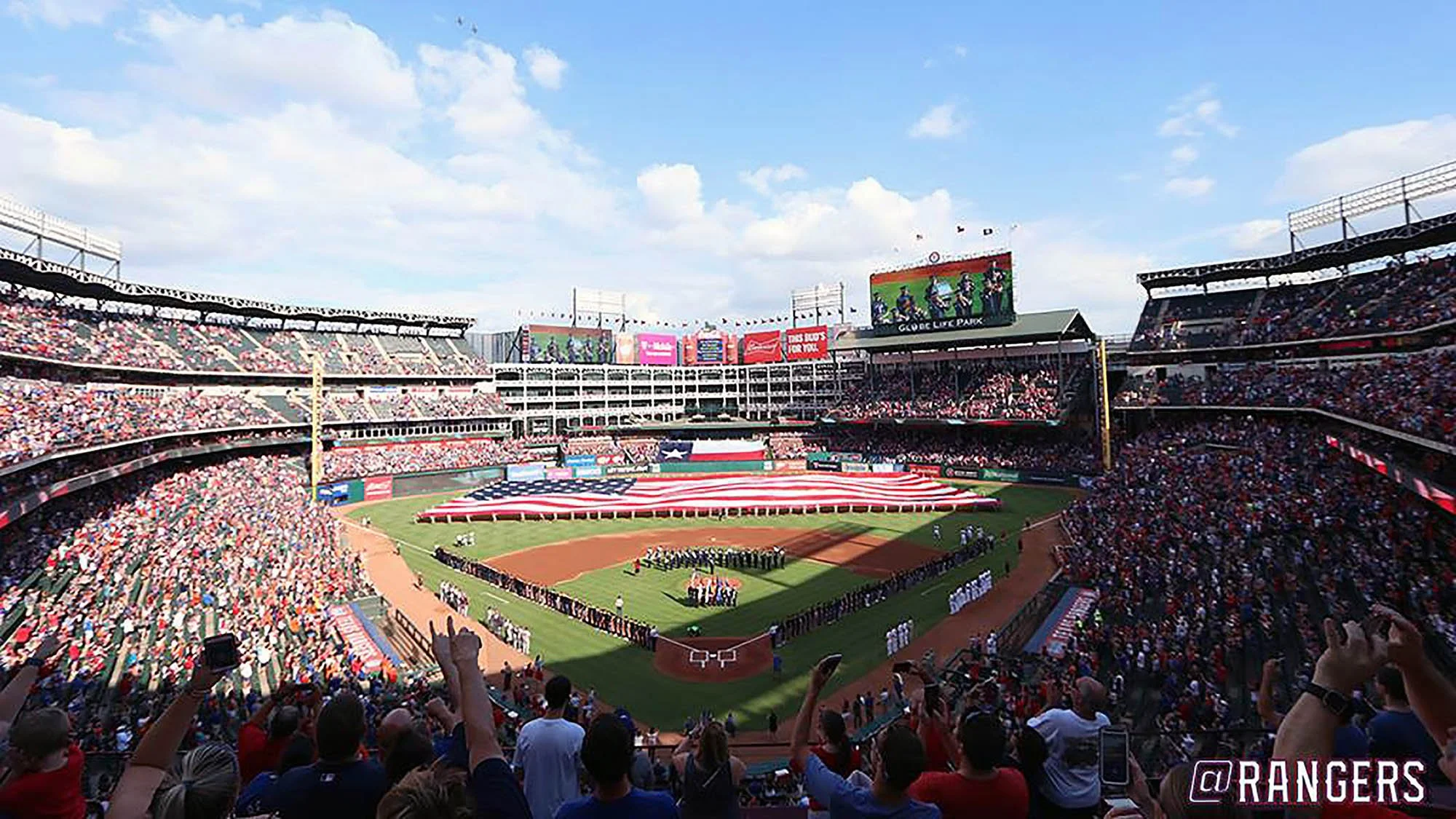
My final assignment was with the U.S. Air Force Band of the West, located at Joint Base San Antonio-Lackland, in Texas. For our 4th of July gig in 2018, our band was invited to perform the U.S. National Anthem for the Texas Rangers’ baseball game in Arlington, TX. In the 4th picture, you see our band on the field with a huge American flag unfolded, and a crowd of thousands cheering us on. When we left the field and returned to the basement dressing rooms, we came across President George W. Bush, who had just thrown out the first pitch of the game. He was friendly and respectful, shook hands with all of us, and thanked us for our service to the country. Actually, President Bush was not the only president I met. During my career, I performed for five U.S. Presidents, at least seven U.S. Ambassadors to various European and Asian countries, several military and civilian VIPs, and millions of enthusiastic audience members all over the United States, Europe, and Asia. All of these distinguished people smiled every time they heard us play our U.S. National Anthem.
From those four gigs and countless others, I have realized what a unique experience it is to perform American music overseas. Hearing American music played overseas almost always brings an emotional response. It is a special experience that reminds you of how far from home you truly are, and yet, even in a foreign country, we felt safe, appreciated, respected, and welcome. Seeing the smiles on the faces of people from different nations when we played various American tunes in a foreign country had an impact on our group and made us realize something: as President John F. Kennedy said (I am paraphrasing), we are all in this together. We are all citizens of Earth, and we all have to get along together if we want to survive and thrive.

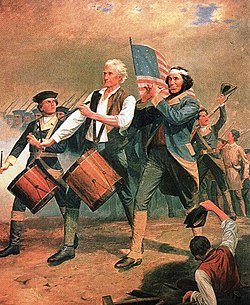
Painting Spirit of '76 by A.M. Willard, 1857, showing fife and drums.
Archibald Willard, Public domain, via Wikimedia Commons
After reading this blog post, you might be inspired to purchase some exceptional, high-quality, hand-crafted digital download sheet music arrangements for clarinet quartets, woodwind quartets, clarinet quintets, woodwind quintets, or clarinet choirs.
Craig Music Publishers is your go-to source for these meticulously hand-crafted arrangements for winds.
Support a veteran-owned business and give your audiences an evening of great music by purchasing digital downloads from our Shop, organized by ensemble type for your convenience.

Music Trivia Answers
First question: Which of these three American composers performed with the Boston Symphony Orchestra?
According to the Heritage Encyclopedia of Band Music, Volume I, Edwin E. Bagley, an American composer born in Craftsbury, VT, in 1857, performed with Leavitt’s Bellringers, Blaisdell’s Orchestra of Concord, NH, the Park Theatre, the Bostonians, the Germania Band of Boston, and the Boston Symphony Orchestra in the late 19th-century. In addition, he was self-taught; he never took any formal instruction on any musical instrument. Although he composed many marches, National Emblem is his most famous.
Rehrig, W. H., & Bierley, P. E. (1991). E. E. Bagley. In The Heritage Encyclopedia of Band Music (Vol. I, pp. 35–35). Essay, Integrity Press.
Second question: Which of these three American composers wrote under several different pseudonyms, including Gus Beans, Harold Bennett, Ray Hall, Harry Hartley, Al Hayes, Will Huff, and Henrietta Moore?
American composer Henry Fillmore, born in Cincinnati, OH, in 1881, used several pseudonyms during his lifetime to prevent the music market from becoming overly saturated with his name. Under these pseudonyms, he created the popular Bennett Band Books, 15 marches featuring the trombone section as “father of the trombone smear,” and in total, over 250 compositions and 750 arrangements. He had a long association with the University of Miami Band, which named their concert hall after him, Fillmore Hall, and created a special collection (The Fillmore Collection at the University of Miami) to display mementos from this revered American composer’s life.
Rehrig, W. H., & Bierley, P. E. (1991). E. E. Bagley. In The Heritage Encyclopedia of Band Music (Vol. I, pp. 238-239). Essay, Integrity Press.
Third question: Which popular dance propelled John Philip Sousa’s “The Washington Post March” to international fame when it replaced the waltz as the most popular dance form of its day in the 1890s?
The “two-step” dance form was introduced at the same time as the publication of Sousa’s The Washington Post. The dance form and spirited march were well suited to each other. When an American dance company adopted it at its annual convention and the “two-step” replaced Johann Strauss’ “waltz” as the popular dance form of the day, both were propelled into international success. Sousa toured the world with his famous band and played not only his own compositions, but also popular music of the day and classical music standards. Of the 136 marches Sousa composed, The Washington Post is second only in popularity to his iconic Stars and Stripes Forever, our national march.
Wind Repertory Project. (2026, April 26). Washington Post March. https://www.windrep.org/Washington_Post_March
Thanks for taking the time to stop by and read my blog. I hope you enjoyed my musings on music and enjoyed my tribute to our country’s 250th birthday. I will be back in two weeks with more anecdotes, memories, and passions for music. In the meantime, you can listen to my newest arrangements for clarinet quintet, Three American Marches, by clicking on the MP3 player below. It is part of a new collection that includes Edwin E. Bagley’s “National Emblem,” Henry Fillmore’s “The Circus Bee,” and John Philip Sousa’s iconic “Washington Post.” After that, you can click here to purchase the collection from our Shop. The three marches are also available to purchase individually. If you have not yet spoken up, tell me your favorite Independence Day story in the comment section below, or which arrangements you might be interested in seeing on CMP. We would love to hear about it. Thanks for stopping by. See you in my next blog!
10 Jul 2026

Cover art for Three American Marches - for Clarinet Quintet, from Craig Music Publishers
