
Blog Post 23: Happy Birthday, America!
🎶history 🎶patriotism🎶Music
Thanks for stopping by, and welcome to my blog! I hope you are having a great June so far. This week, we are getting a head start on America’s Independence Day, as we celebrate our 250th birthday! In this blog post, I will:
🎉Review: The history of our national anthem
🎉Reflect: What the anthem means to me as a veteran
🎉Revere: Celebrating 250 years of America through music
By the way, have you performed any of our CMP arrangements? If so, we would greatly appreciate it if you could leave a review. Click here to leave a review/comment on my CMP YouTube Channel. If you have posted a YouTube video of a CMP arrangement, do not forget to tag us on your channel, and we will tag you back. Thanks so much! Happy practicing!
Music Trivia Questions
Before we continue, here are three music trivia questions to challenge you; I will reveal the answers towards the end of this blog post. I hope you enjoy them.
🎶First, which civilization provided the earliest tangible evidence of organized military musicians?
🎶Second, what was the name of the original tune upon which our national anthem is based?
🎶And third, which notable American composer was part of the five-man team responsible for writing the first arrangement of our
Star-Spangled Banner?
Tell me your answers in the comments below, or feel free to share any other interesting information you might know about these three subjects. Now, let’s continue with the topic at hand.
Happy Independence Day, America!
What does this holiday mean to you? Do you have any memorable July 4th stories to share? How do you and your family celebrate America’s Independence Day? Tell us about it in the comment section at the end of this blog post.
Our National Anthem
MUSIC: Our national anthem, The Star-Spangled Banner, started out life quite differently from the patriotic tune we know today. The original tune was written in the late 18th century by John Stafford Smith, an English organist of the Chapel Royale and a member of a London social club called the Anacreontic Society. This society met roughly twice a month for a formal concert, dinner, and social hour, when they would sing popular songs of the day. The original words of this tune were written by Ralph Tomlinson, the president of that society, and the tune was originally called "To Anacreon in Heaven." The song became quite popular, and by the early 19th century, over 80 versions had been published, as copyright protection was not yet in place (1).
LYRICS: In 1814, after witnessing the Battle of Baltimore at Fort McHenry, American poet Francis Scott Key was inspired to write his iconic poem “The Defense of Fort McHenry,” which later became the lyrics of our national anthem. But it took over a hundred years for that to happen. In the meantime, the song grew in popularity in the U.S., and by 1899, the U.S. Navy officially adopted “The Star-Spangled Banner” for its formal ceremonies. In 1916, President Woodrow Wilson ordered its use at all military occasions. Then, in 1930, the Veterans of Foreign Wars obtained five million signatures for their petition to make this tune our national anthem. On 3 March, 1931, President Herbert Hoover signed into law the congressional act selecting The Star-Spangled Banner as our official U.S. National Anthem (2).
Since that time, the Star-Spangled Banner has been used for formal ceremonies, sporting events, and patriotic celebrations. In fact, during World War II, it became a tradition to play the anthem before pro baseball games and pro football games. Other songs were also considered for selection as our national anthem, including “Hail, Columbia,” “My Country 'tis of Thee” (based on “God Save the King, " the United Kingdom’s National Anthem), and “America the Beautiful.” The song is well-known for being a bit difficult to sing because it encompasses the range of a twelfth. Even professional singers have been known to forget the lyrics, which is one reason the song is often pre-recorded for live performances at sporting events (3).
The U.S. national anthem is particularly important to military bands. For 24 years, I toured around the United States, Europe, Northern Africa, and Asia with the U.S. Air Force Bands, performing the anthem at concerts, ceremonies, and other formal events. I have performed the anthem over fourteen hundred times in my Air Force Band career, with our large concert band, the smaller ceremonial band, and even smaller clarinet quartet and woodwind quintet. No matter the size of the group, the anthem is a crucial component in honoring our country. The impact of our national anthem on our country is tremendous. You can see it when people hear our national anthem: they wave the US flag, place their hands over their hearts, or men take off their hats and do the same. The Star-Spangled Banner unites us all and instills in us a sense of pride in being Americans.
George Washington’s Mount Vernon. (n.d.). Was the “Star-Spangled Banner” an old drinking song?https://www.mountvernon.org/library/digitalhistory/colonial-music-institute/essays/star-spangled-banner
National Park Service. (2023, January 13). "The Star-Spangled Banner”—From Song, to Anthem, to Icon. Fort McHenry. https://www.nps.gov/fomc/learn/historyculture/the-national-anthem.htm
Wikipedia contributors. (2026, May 20). The Star-Spangled Banner. In Wikipedia, The Free Encyclopedia. Retrieved 22:21, June 23, 2026, from https://en.wikipedia.org/w/index.php?title=The_Star-Spangled_Banner&oldid=1355163755
Photo of The U.S. Air Force Band of the Golden West performing with the San Francisco Symphony at Shoreline Amphitheatre, Mountain View, CA, July 4th 2013
What the nATIONAL anthem means to me as a Musician and a veteran


Here are four images from my travels in the U.S. and Europe while serving with the U.S. Air Force Bands. These are four places around the world where I have performed the U.S. National Anthem, each of which holds special significance for me. The first eight years of my Air Force Band career were spent with the U.S. Air Force Band of Liberty (now deactivated) at Hanscom Air Force Base, MA. Every summer, we would perform a series of local concerts we would call “out-and-backs,” where we played outdoor summer pops/patriotic concerts around New England. We would also go on summer concert tours of those states: Connecticut, Maine, Massachusetts, New Hampshire, New York State, Rhode Island, and Vermont. One of my fond memories of July 4th gigs at that assignment was a local performance we did in Danvers, MA (first picture), when our clarinet section performed Leroy Anderson’s perennial favorite “Clarinet Candy.” As a clarinetist, it was a treat for our band to feature our incredible clarinet section on a concert. It was a great gig. New England audiences always gave us a great reception. They loved hearing American classics, from Anderson to Sousa, and Gershwin to Copland.
My next assignment was with the United States Air Forces in Europe (USAFE) Band at Sembach Air Base, Germany. Each year, all seven of our small ensembles would cover two countries each over the 4th of July week, if our budget allowed. That way, we are supporting as many US Embassies as we can in one year with their July 4th festivities. While stationed in Germany, I performed the U.S. National Anthem in Azerbaijan, Ireland, Russia, Slovakia, Turkey, and Ukraine. The second picture is from our July 4th gig in Kyiv, Ukraine; it was very memorable. We performed, as usual, at the U.S. Ambassador’s residence, this time in Kyiv. There were over a thousand people in attendance, including both Americans and Ukrainians, as well as other visiting VIPs from nearby countries. Their faces lit up when they heard the opening notes of the Star-Spangled Banner. Some of them teared up as well. Our anthem has extra special meaning when you are stationed far away from your family and friends back in America.
My third assignment was with the U.S. Air Force Band of the Golden West, located at Travis Air Force Base, in northern CA. Our band members were fortunate there because both the Los Angeles Philharmonic and the San Francisco Symphony regularly performed with us at our July 4th concerts. In the third picture, you see us performing with the Los Angeles Philharmonic at the famed Hollywood Bowl on July 4th, for a crowd of over 20,000, under the baton of maestro John Morris Russell. It was a treat to perform with this world-class orchestra; we played the “March” from Gustav Holst’s Suite No. 1 for Band in Eb, Morton Gould’s American Salute, and finished with John Philip Sousa’s Washington Post and The Stars and Stripes Forever. Great memories, a great gig, and a great way to serve your country.
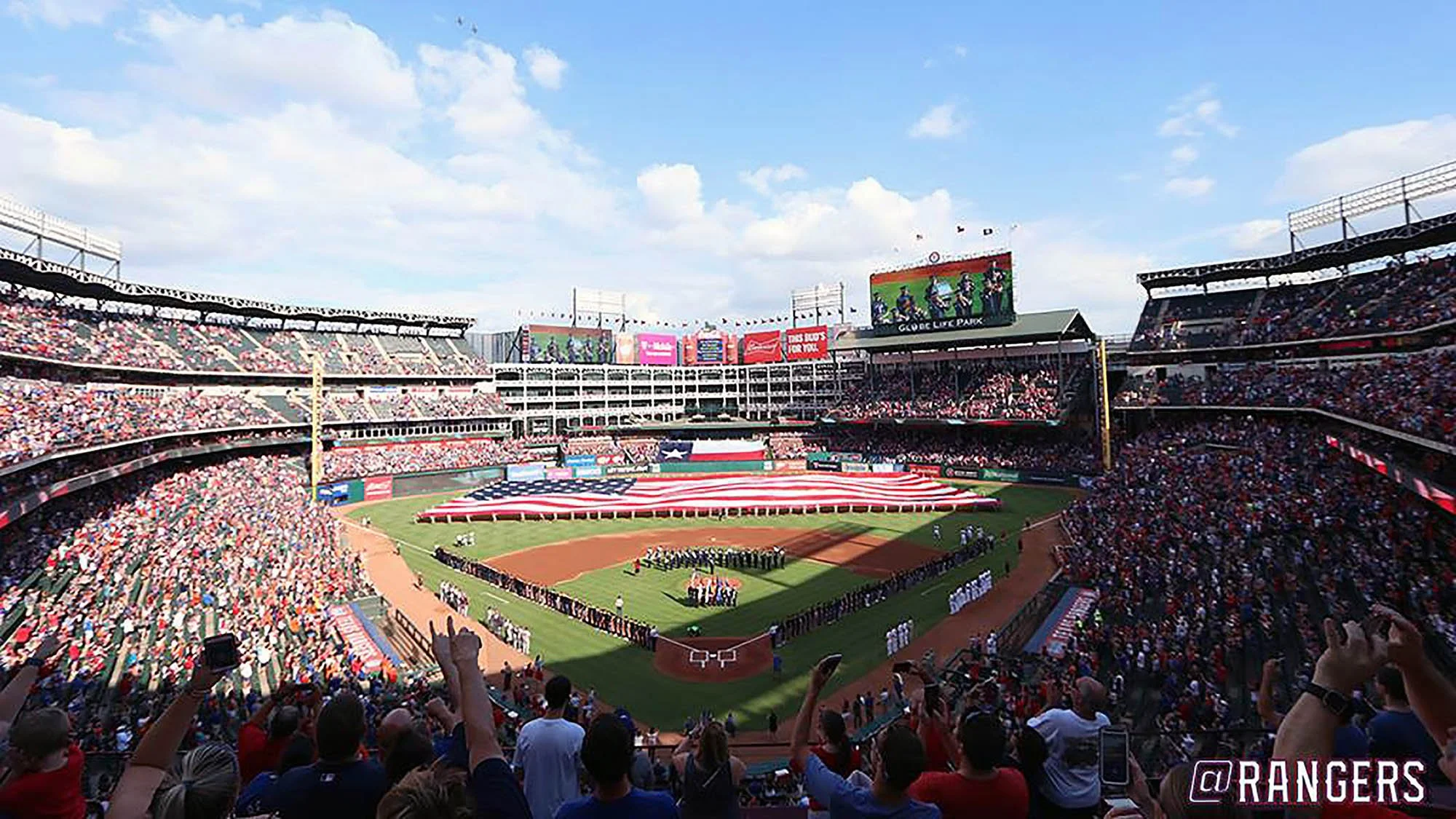
My final assignment was with the U.S. Air Force Band of the West, located at Joint Base San Antonio-Lackland, in Texas. For our 4th of July gig in 2018, our band was invited to perform the U.S. National Anthem for the Texas Rangers’ baseball game in Arlington, TX. In the 4th picture, you see our band on the field with a huge American flag unfolded, and a crowd of thousands cheering us on. When we left the field and went back into the basement, we came across President George W. Bush, who had just thrown out the first ball of the game. He was friendly and respectful; he shook hands with all of us and thanked us for our service to the country. Actually, President Bush was not the only president I met. During my career, I performed for five U.S. Presidents, at least seven U.S. Ambassadors to various European and Asian countries, several military and civilian VIPs, and millions of enthusiastic audience members all over the United States, Europe, and Asia. All of these distinguished people smiled every time they heard us play our U.S. National anthem.
From those four gigs and countless others, I have realized what a unique experience it is to perform the U.S. National Anthem overseas. In the U.S., we expect to hear the anthem at all formal and patriotic events, but overseas, you would, of course, hear it played less often. When we performed at military ceremonies overseas, we first played the host nation’s anthem, then the U.S. anthem, as protocol dictates and out of respect for our hosts. Hearing the anthem played overseas almost always brings an emotional response. It is a surreal experience that reminds you of how far from home you truly are, and yet, even in a foreign country, we felt safe, appreciated, respected, and welcome. Seeing the smiles on the faces of people from different nations when we played the U.S. national anthem in a foreign country had an impact on our group and made us realize something: as President John F. Kennedy said (I am paraphrasing), we are all in this together. We are all citizens of Earth, and we all have to get along together if we want to survive and thrive.
Celebrating 250 years of democracy through music
Military musicians have been around for thousands of years, with documentation dating back as far as the 7th century BC in China and the Bible (Book of Numbers, Chapter 10, Verse 9). For centuries, armies have used horns, trumpets, and drums to sound retreat, boost morale, and lead the charge into battle. During the Revolutionary War, the fife and drums were used to march the men into battle, as seen in the picture below. During the Civil War, marching songs lifted spirits. During WWI and WWII, the tune “Colonel Bogey” was popular with the troops. Music is a universal language that has helped lift the spirits of troops facing danger, inspired them to fight even harder to defend their freedoms, and stoked their pride in their country and their branch of service at formal military events. From the very beginnings of our nation, through the Civil War, two World Wars, conflicts in Korea, Vietnam, and the Middle East, music has supported our troops, inspired future musicians, and helped us honor our country’s veterans. Music has been a crucial yet often overlooked element in our country's success and will definitely be a strong force in helping us celebrate our 250 years of democracy.
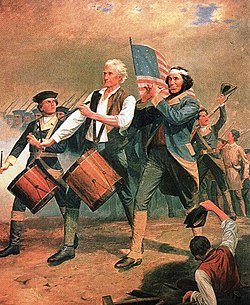
Painting Spirit of '76 by A.M. Willard, 1857, showing fife and drums.
Archibald Willard, Public domain, via Wikimedia Commons
After reading this blog post, you might be inspired to purchase some exceptional, high-quality, hand-crafted digital download sheet music arrangements for clarinet quartets, woodwind quartets, clarinet quintets, woodwind quintets, or clarinet choirs.
Craig Music Publishers is your go-to source for these meticulously hand-crafted arrangements for winds.
Support a veteran-owned business and give your audiences an evening of great music by purchasing digital downloads from our Shop, organized by ensemble type for your convenience.

Music Trivia Answers
First question: Which civilization provided the earliest tangible evidence of organized military musicians?
According to the U.S. Army Band History website, it was the Roman civilization that first mentioned organized military musicians:
Roman musicians, called aenatores, performed duties often required of military musicians today. They signaled troop movements, performed for official functions and funerals, played on the march, and provided morale support for the troops. The Romans provide the first known printed explanation for having military music, "To fire up attacking troops and to uphold their spirits while they endure privations and fatigue.
Ortiz, B. (2024, July 7). U.S. Army Band History. U.S. Army Adjutant General’s Corps. https://agcra.com/blog/u-s-army-band-history
Second question: What was the name of the original tune upon which our national anthem is based?
Our national anthem, the Star-Spangled Banner, was originally a song created for a London gentlemen’s club called The Anacreontic Society. They met twice a month for a formal concert, dinner, and social time. The song, called “To Anacreon in Heaven,” was written about a 6thC BC Greek poet named Anacreon, who wrote about women and wine. John Stafford Smith (1750–1836), the organist at the Chapel Royal in London, wrote the music, and Ralph Tomlinson (1744–1778) wrote the lyrics. The song was first published in 1779, and since there were no copyright laws at the time, it was often parodied or paired with new lyrics and republished. In fact, by the early 19th century, over 80 versions of this popular song had been written. Francis Scott Key wrote the lyrics in 1814 for the version we know today as our national anthem, after witnessing the American flag flying over Fort McHenry during the War of 1812. But it was not until 1931 that President Herbert Hoover signed a congressional resolution adopting the tune as the official U.S. National Anthem.
George Washington’s Mount Vernon. (n.d.). Was the “Star-Spangled Banner” an old drinking song?https://www.mountvernon.org/library/digitalhistory/colonial-music-institute/essays/star-spangled-banner
Third question: Which notable American composer was part of the five-man team responsible for writing the first arrangement of our Star-Spangled Banner?
In the early 20th century, various versions of our Star-Spangled Banner were in use. President Woodrow Wilson wanted a definitive version for the country and commissioned five leading American musicians to write an official arrangement. Those five men were Walter Damrosch, Will Earhart, Arnold J. Gantvoort, Oscar Sonneck, and John Philip Sousa. According to Wikipedia, “The standardized version that was voted upon by these five musicians premiered at Carnegie Hall on December 5, 1917.”
Wikipedia contributors. (2026, May 20). The Star-Spangled Banner. In Wikipedia, The Free Encyclopedia. Retrieved 22:21, June 23, 2026, from https://en.wikipedia.org/w/index.php?title=The_Star-Spangled_Banner&oldid=1355163755
Thanks for taking the time to stop by and read my blog. I hope you enjoyed my musings on music and enjoyed my tribute to our country and our national anthem. I will be back in two weeks with more anecdotes, memories, and passions for music. In the meantime, you can listen to my newest arrangements for clarinet quintet, Three American Marches, by clicking on the MP3 player below. It is part of a new collection that includes Edwin E. Bagley’s “National Emblem,” Henry Fillmore’s “The Circus Bee,” and John Philip Sousa’s iconic “Washington Post.” After that, you can click here to purchase the collection from our Shop. If you have not yet spoken up, tell me in the comment section below what our national anthem means to you, any stories you would like to share about your Independence Day experiences, or which arrangements you might be interested in seeing on CMP. We would love to hear about it. Thanks for stopping by. See you in my next blog!
26 Jun 2026

Cover art for Three American Marches - for Clarinet Quintet
