
Blog Post 4: My Favorite March
John Philip Sousa’s The Black Horse Troop
Thanks for stopping by, and welcome to my blog! In honor of Veterans’ Day this year, I would like to write a blog post about my favorite march, but I also want to take the time to thank all veterans for their selfless service to this great country. We would not be where we are today without the sacrifices made by our uniformed service members. Thank you all for your dedication and service to our country. It is much appreciated.

My favorite march is the Black Horse Troop March by America’s march king, John Philip Sousa. Actually, I have quite a few favorite marches, including some non-traditional marches. My top five include Black Horse Troop March, Florentiner March by Julius Fučík, Marche Joyeuse by Emmanuel Chabrier, L'Inglesina (The Little English Girl) by Davide Delle Cese, and March of the Belgian Paratroopers by Pierre Leemans. Therefore, my favorite marches originate from America, Bohemia (present-day Czech Republic), France, Italy, and Belgium. Oddly enough, I developed my love for these European marches while playing them in junior high and school bands, not necessarily when I was stationed in Germany with the U.S. Air Forces in Europe (USAFE) Band. However, that assignment greatly contributed to my appreciation of these favorite band classics. What’s your favorite march? Tell me in the comments below.
I first heard the Black Horse Troop March when I was in 7th grade at Westwood Junior High School, in the Dallas suburb of Richardson, Texas. Our Symphonic Band rehearsed around 11:00 every day, and my lunch hour coincided, so I would hurry and eat my lunch, then walk into the band room, climb the stairs, and sit there listening to them rehearse. They sounded amazing to me, which they were. That band regularly won the Texas Honor Band award; Richardson schools have always had a great music program. One day, I went in to listen, and they were playing the Black Horse Troop March. I had never heard this piece before, and was instantly drawn to its lilting melody and amiable 6/8 meter. I quickly grew to love this piece, and by the time I became an arranger for the Air Force Bands, I decided this would be my first march to arrange for a clarinet quartet (CQ).
Black Horse Troop March quickly became the “signature tune” for our quartet at the Air Force Band of Liberty, my first assignment in the U.S. Air Force. We performed it for military ceremonies, background dinner music gigs, and at all of our recitals, where it quickly became a favorite among our audiences. The tune works well for winds, so I decided to arrange it for woodwind quintet (WQ) as well. This new setting allowed me to add some fun double-tonguing licks for the French horn player, which I am sure they enjoyed, as opposed to the upbeats or “oom-pahs” they normally played in a march. This new technical lick, along with the bass line and its corresponding upbeats, does a convincing job of musically portraying a horse’s gait.
One of the iconic elements of any Sousa march is the use of an obbligato line in the final strain, or “last 32” as we always called it, in the Air Force Bands. I always love hearing this perky, cheerful line, as it adds a new, exciting, technical element to music that the listener has previously heard in the Trio section. The first time through the “last 32,” it’s all about the obbligato, so usually everyone else is marked piano or pianissimo, so that this line can come through loud and clear. The third strain, or “dogfight,” as band geeks (like me) refer to it, is also an energetic, almost antagonistic section of the march that deserves a mention. In typical Sousa fashion, the ensemble will play down to a niente dynamic right before the “dogfight” and then come in with an aggressive fortissimo entrance out of nowhere. It’s a beautiful dynamic contrast that makes the piece just a bit more interesting and effective. In the clarinet quartet version of this piece, especially, playing down to niente is a clarinetist’s forte, so this effect works exceptionally well for this type of ensemble.
My CQ and WQ arrangements of this beloved march turned out quite well, and they are two arrangements of which I am very proud. The WQs I performed with in the Air Force Bands would regularly program this piece, finding it to be an audience pleaser that worked well for any recital, protocol function, or special event. This multi-use work is published by the United Music & Media Publishers (UMMP, formerly ALRY Publications), as part of a Three Sousa Marches set, including Semper Fidelis and Hands Across the Sea, making it a trio of Sousa’s most popular marches. This special three-march arrangement set has been recognized for its merit by the Texas UIL Committee, which chose it for its Prescribed Music List for Woodwind Quintet.
Thanks for taking the time to stop by and read my blog. I hope you enjoyed my musings on music. I’ll be back next week with more anecdotes, memories, and passions for music. In the meantime, you can listen to my arrangement of this delightful march for WQ by clicking on the MP3 player below, and then click here to purchase it from UMMP. Additionally, if you would like to purchase my clarinet quartet arrangement of this march, click here to visit my shop. Did you like this arrangement of a classic Sousa march? If so, tell me your thoughts about it in the comments below. Thanks for stopping by. See you in my next blog, and Happy Veteran’s Day!
7 November 2025
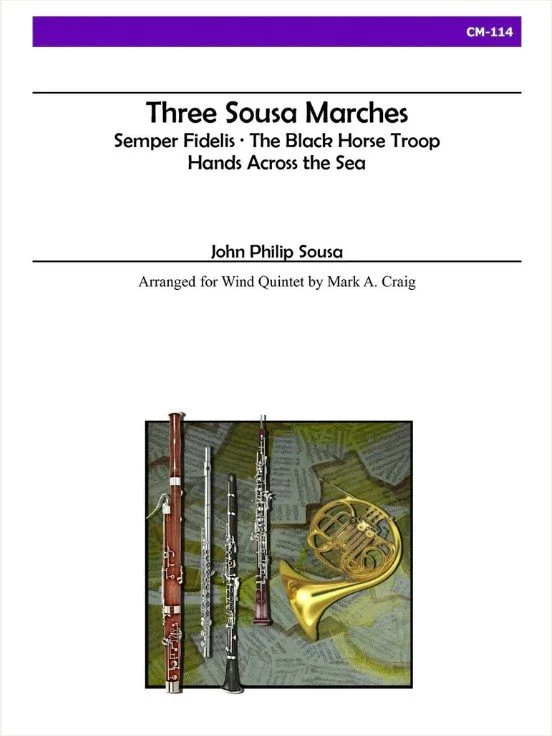
Sousa: Three Marches for Woodwind Quintet
