
Blog Post 5: Mozart Rondo
Inspiration behind my new arrangement of Mozart’s “Rondo,” from Serenade No. 10, KV 361 “Gran Partita”
Thanks for stopping by, and welcome to my blog! Where can I purchase digital sheet music for clarinet quintets online? Craig Music Publishers! In fact, this week, I will be discussing my new arrangement for clarinet quintet of the “Rondo” from Wolfgang Amadeus Mozart’s masterpiece, Serenade No. 10 KV 361 “Gran Partita.” I have been a fan of Mozart for years now. To get this started, I would like to share a picture I took (see below) in December 2023 of Mozart’s Geburtshaus (or birth house) in Salzburg. For Mozart enthusiasts, this is like Mecca! Have you visited any of the Mozart sites in Salzburg or Vienna? Tell me about your experience in the comments below. I would love to hear about it.
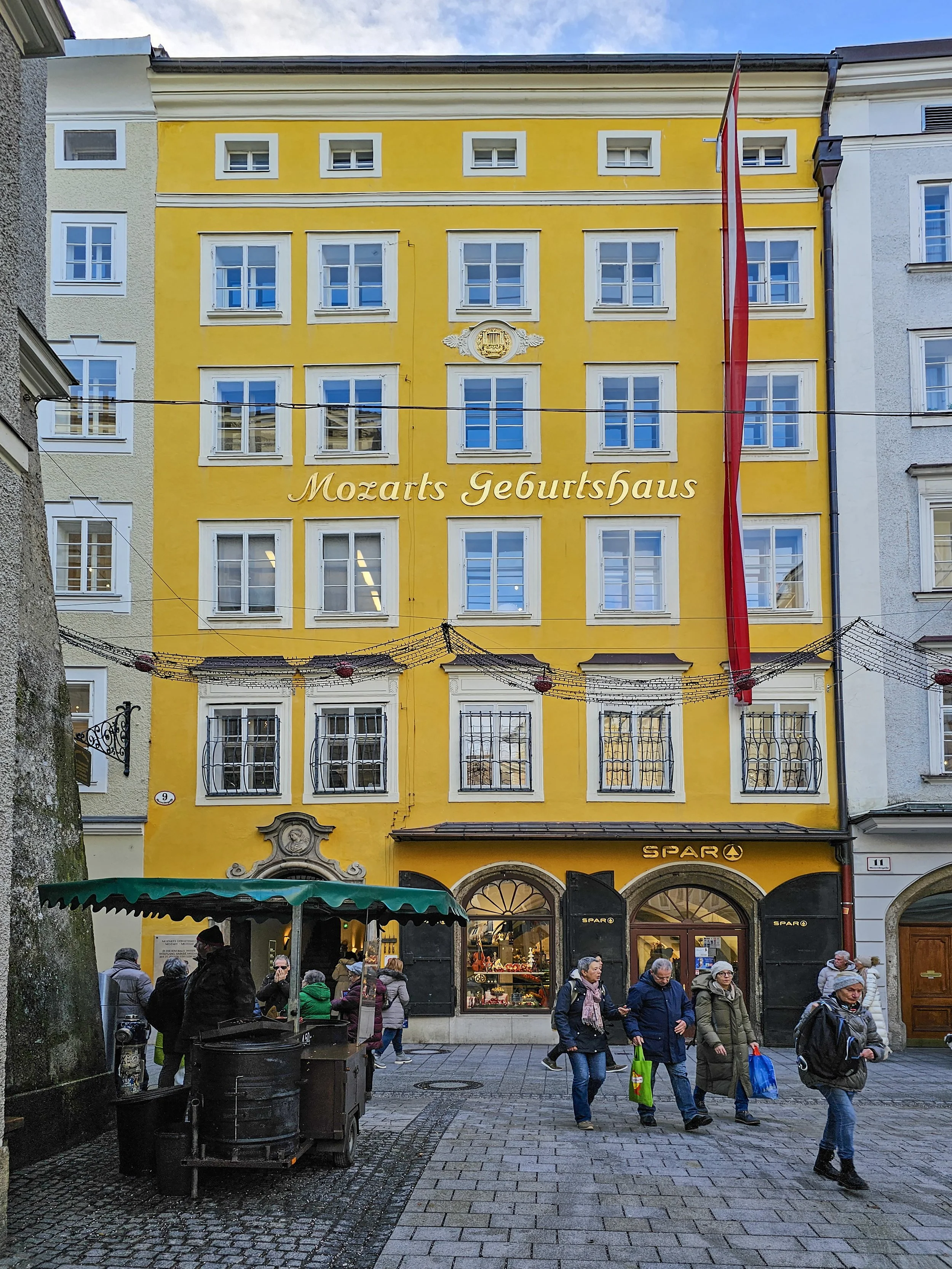
Wolfgang Amadeus Mozart Geburtshaus with Austrian flag, Getreidegasse 9, Salzburg, Austria, Dec 2023
While visiting Salzburg, I took a guided tour of Mozart’s birthplace, enjoying the many artifacts this world-renowned museum exhibits regularly, including letters he wrote to his family, several original manuscript scores of his work, several paintings of the family, Mozart’s violin and fortepiano, his personal items, like a cloth wallet and snuff box, and various items from global productions of his operas. I also took a guided tour of the nearby Mozart Wohnhaus, formerly known as the “Tanzmeisterhaus,” now run by the International Mozarteum Foundation, where he resided from 1773 to 1780. What a treat and a blessing to see both of these amazing museums and to see how Mozart lived during his early years in Salzburg. It was a wonderful learning experience and gave me a better understanding of this legendary composer.
One of Mozart’s compositions that has changed my life is his “Gran Partita” serenade. I first heard this fine work when I was a freshman in college, studying clarinet at Southern Methodist University (SMU) in Dallas. I had some free time between classes, so one day I decided to see a matinee performance of the new movie Amadeus, with Tom Hulce and F. Murray Abraham. The movie is life-changing. I was impressed by the music, the scenery (the movie was filmed in Prague, Czech Republic), the sets, the costumes, and the story of the (fictional) rivalry between Italian composer Antonio Salieri and Austrian composer Wolfgang Amadeus Mozart. However, what moved me the most in this film was when Salieri describes his first time hearing Mozart's music, using the example of the “Adagio” from the Gran Partita. That scene was so poignant and the music so beautiful, especially the opening oboe solo. Hearing this serenade changed my life forever. To me, that’s what music is all about: making an emotional connection with your audience, which this piece has done for many people with its delightful melodies and luxurious tones.
What is your favorite movement from the Gran Partita? Tell me in the comments below. One of my favorite movements from this serenade is the “Rondo-Finale,” which presents technical challenges for its performers and rewards us with a delightful, exhilarating movement full of joy, featuring a spirited, cheerful recurring melody. My first arrangement of this movement was for a clarinet quartet (CQ) while stationed at Hanscom Air Force Base, MA, with the U.S. Air Force Band of Liberty. Our quartet enjoyed performing this movement regularly throughout New England and New York state, and it quickly became an audience favorite as well. This CQ version was awarded the distinction of being chosen for the Florida Bandmasters Association Woodwind Solo & Ensemble Music List and is published by United Music and Media Publications. A few years later, I arranged the Rondo for woodwind quintet (WQ) while stationed in Germany with the US. Air Forces in Europe Band. My quintet version was awarded the distinction of being chosen for the Texas UIL Prescribed Music List and is also published by United Music and Media Publications.
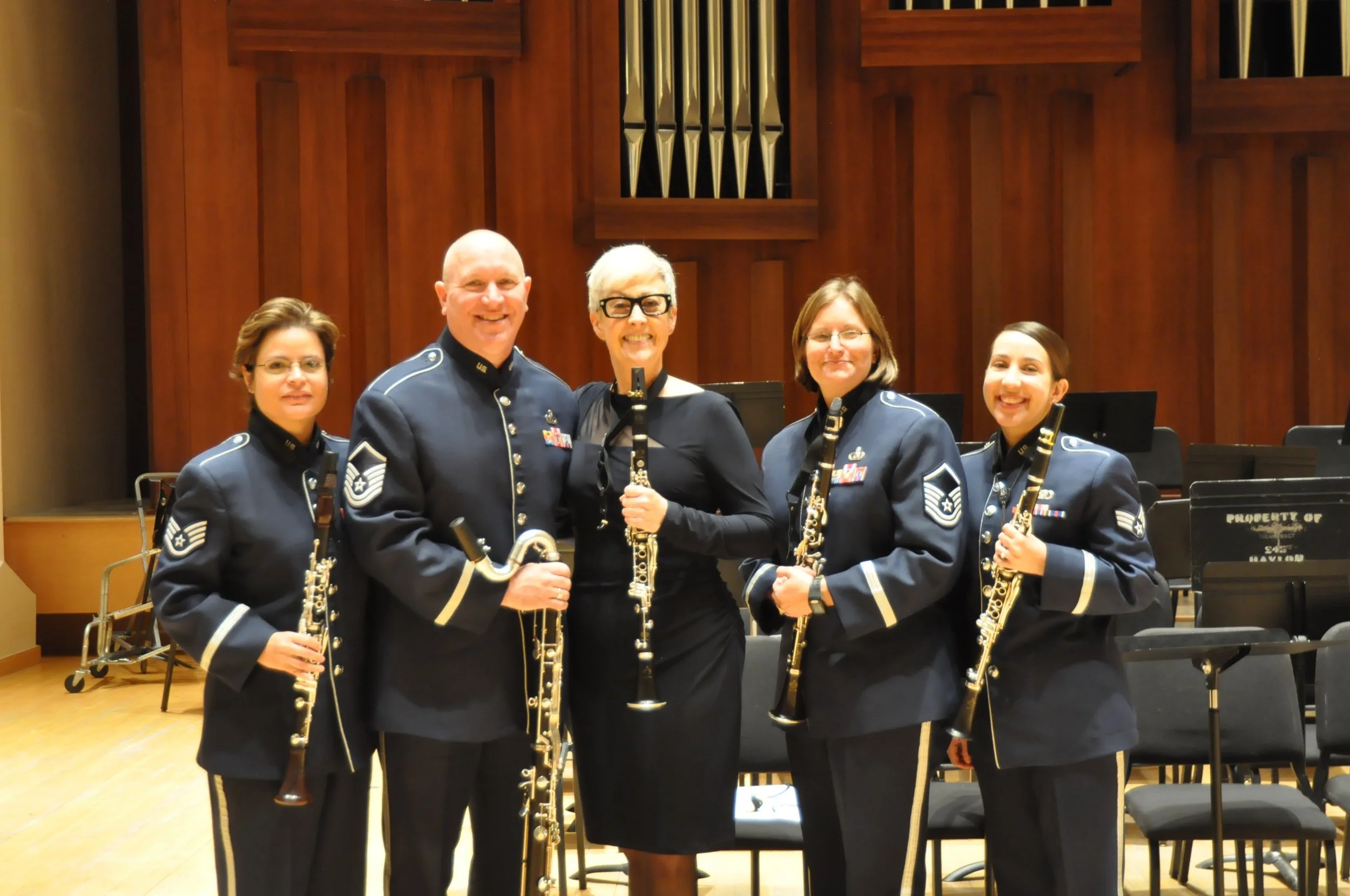
The U.S. Air Force Band of the West Mission Winds Clarinet Quartet with special guest Paula Corley, at the Clarinet Festival, Baylor University, Waco, Texas, April 2016
Years later, at my final Air Force assignment with the U.S. Air Force Band of the West, our clarinet quartet performed a recital with my former SMU colleague and dear friend, Paula Corley (see photo above), a Buffet and Vandoren artist who was the clarinet professor at Texas Lutheran University. We collaborated on a commission by her friend and composer, Clifton Jameson Jones, for a new clarinet quintet that he was writing for her, entitled "Roadtrip." We performed the world premiere of that new piece with Paula at the Baylor University Clarinet Festival in April 2016.
For that program, Paula graciously agreed to perform another two selections with us. After some discussions, we agreed that I would write a clarinet quintet (CQ5) arrangement of the Rondo, which would be our closing piece on the program, and also a new arrangement of Henry Fillmore’s Circus Bee, a dynamic, high-speed march, as our encore with Paula. It was a true delight to perform again with my dear friend, a wonderful clarinetist and pedagogue. The audience fell in love with both her and our two new pieces, particularly the Rondo, which received a standing ovation! And that is how this Mozart arrangement came about.
Thanks for taking the time to stop by and read my blog. I hope you enjoyed my musings on music. I’ll be back next week with more anecdotes, memories, and passions for music. In the meantime, you can watch a live performance of my arrangement of this delightful rondo for CQ5 by clicking on the photo link below; I came across this video on the U.S. Air Force Band of the West YouTube Channel. Then click here to purchase it from my store. Additionally, if you would like to purchase my clarinet quartet arrangement of this piece, click here to purchase it from the UMMP store. If you are interested in my WQ arrangement, click here to purchase it from the UMMP store. What is your favorite Mozart piece? And which is your favorite Mozart concerto? Tell me your thoughts about it in the comments below. Thanks for stopping by. See you in my next blog!
14 November 2025
Video of the U.S. Air Force Band of the West Mission Winds clarinet quartet with special guest Paula Corley performing the “Rondo” from Mozart’s Gran Partita Serenade at the Baylor University Clarinet Festival in April 2016.

Mozart: “Rondo” from Serenade No. 10 KV 361 “Gran Partita” - arranged for Clarinet Quintet
