
Blog Post 19: National Emblem - for Clarinet Quintet
PLUS: Tips on arranging for Clarinet Quintet
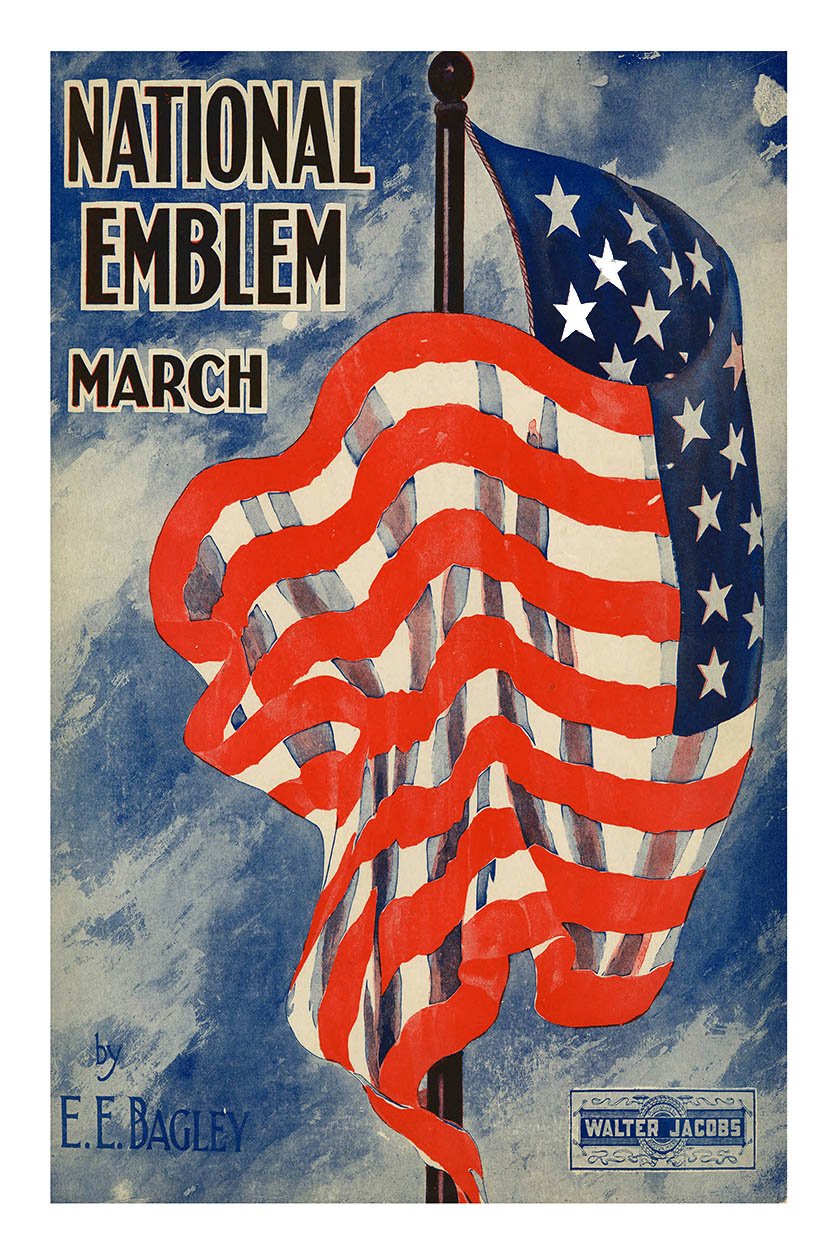
Edwin E. Bagley’s 1906 publication of the National Emblem March.
Public Domain
Thanks for stopping by, and welcome to my blog! I hope you had a great week. In this blog post, I will discuss my hot-off-the-press arrangement for clarinet quintet of Edwin E. Bagley’s iconic march, National Emblem. You may not recognize that title at first, but you are sure to know this beloved American classic from its popularity at summer pops concerts, patriotic events, and movies like Miracle on 34th Street, The Dirty Dozen, Protocol, and Hot Shots!. I will also share some tips on arranging for a clarinet quintet.
By the way, have you performed any of our CMP arrangements? If so, we would greatly appreciate it if you could leave a review. Click here to leave a review on my CMP YouTube Channel. If you have posted a YouTube video of a CMP arrangement, do not forget to tag us on your channel, and we will tag you back. Thanks so much! Happy practicing!
Before we continue, here are three music trivia questions about the National Emblem march to challenge you; I will reveal the answers towards the end of this blog post. I hope you enjoy them.
First, which familiar American tune is quoted within Edwin E. Bagley’s National Emblem?
Second, can you name any other march by Edwin E. Bagley?
And third, which musical instruments did Edwin E. Bagley play professionally?
Tell me your answers in the comments below, or feel free to share any other interesting musical facts you might know about the National Emblem march or Edwin E. Bagley. Now, let’s continue with the topic at hand.
Edwin Eugene Bagley
New England has produced some fine American composers, among them Leroy Anderson, from Cambridge, MA; Amy Beach, from Henniker, New Hampshire; Leonard Bernstein, from Lawrence, MA; George M. Cohan, from Providence, R.I.; Charles Ives, from Danbury, CT; Walter Piston, from Rockland, ME; and Edwin Eugene Bagley, who was born in Craftsbury, VT. This American-born composer and performer is best known for his symphonic band compositions, and known in New England as the “Vermont March King,” but he also made a living as a vocalist, comedian, solo cornetist, trombonist, and baritone player with vaudeville troops, opera companies, professional bands, professional chamber music ensembles such as the early 20th-century Boston Orchestral Players, and orchestras, such as the Boston Symphony. He composed several marches, including The Ambassador, America Victorious, Front Section, and The Imperial, but none achieved as much fame as his National Emblem March (1902).
Program Notes for Band. (2023, August 22). National Emblem March. Wind Repertory Project. https://www.windrep.org/National_Emblem_March
Whitwell, D. (2010, February 24). Bagley, Edwin Eugene. Grove Music Online. Retrieved 26 Apr. 2026, from https://www.oxfordmusiconline.com/grovemusic/view/10.1093/gmo/9781561592630.001.0001/omo-9781561592630-e-1002084811
National Emblem March
When I was a kid growing up in Texas, every year at Christmas time, we would watch the classic movie Miracle on 34th Street. In the movie, when we get our first glimpse of the Annual Macy’s Thanksgiving Day parade (which was the actual Macy’s parade filmed live in 1946 for the movie), there is a marching band playing the trio section from Edwin E. Bagley’s iconic American march, National Emblem. Little did I know back then that I would go on to perform that piece hundreds of times in my future Air Force Band career. This favorite American march brings back fond memories for many who remember it from this movie and other films in which it appeared. Edwin Bagley’s National Emblem has become synonymous with patriotic music, military ceremonies, and Americana celebrations.
In addition to patriotic celebrations in America, this march is also performed regularly by U.S. military bands when presenting and retreating the colors (flags) at formal ceremonies. Also, this piece is used to “march in” the cadets every year for the U.S. Air Force Academy Graduation Parades at the Air Force Academy in Colorado Springs, CO. Additionally, this march has had a lasting impact on our country’s leading musicians. The famous American march king, John Philip Sousa, was asked once to name the three most effective street marches ever written. He chose two of his own marches, The Stars and Stripes Forever and Washington Post, as well as Bagley’s National Emblem. Finally, the legendary Eastman Wind Ensemble founder and conductor Frederick Fennell, one of my personal favorites, also listed this piece as his all-time favorite march. According to Wikipedia, Fennell described National Emblem in this way: "as perfect a march as a march can be.”
As for thematic material in this march, according to the Wind Repertory Project, “…In addition to The Star Spangled Banner, which provided melodic material for the first strain and trio, Bagley's memories of the herds of buffalo he had seen while crossing the Western prairies in the 1870s and 1880s inspired the heavy, repetitive beats heard in the trio.” The march was written in 1902 and published in 1906. It features interesting obbligato lines for the woodwinds in both the first strain and the “Last 32,” and, again, a bombastic statement of our National Anthem, offering interesting parts for both woodwinds and low brass. In an unusual move for the time, Bagley did not incorporate a dogfight, breakstrain, or stinger in this march. Yet it became Bagley’s most famous march and has since become a staple of American symphonic and military bands as well as pops orchestras.
Program Notes for Band. (2023, August 22). National Emblem March. Wind Repertory Project. https://www.windrep.org/National_Emblem_March
Wikimedia Foundation. (2025, December 5). National Emblem. Wikipedia. https://en.wikipedia.org/wiki/National_Emblem#Legacy
Edwin E. Bagley’s National Emblem March, arranged for Clarinet Quintet
Available here in our Shop!
arranging for Clarinet Quintet
When I write for a clarinet quintet, I usually opt for the most often utilized instrumentation for these unique ensembles: four Bb clarinets and a bass clarinet. Sometimes, if the lead line is pitched very high, I might include the Eb clarinet, but I always include an alternate Bb part. I do not see a need for two bass clarinets in an ensemble this size, but I would consider using them for a clarinet choir. I will sometimes also employ an alto clarinet with an alternate Bb clarinet part to add some richness, or at least a different tonal color, to the group's overall sound. Any of these instrument combinations works well for a clarinet quintet. However, one challenge that arrangers face when writing for a clarinet ensemble is the overabundance of homogenous sounds or too many similar tones.
Clarinet ensembles can often sound like an accordion. The sounds are so similar that there is no depth of sound or diversity in the ensemble’s tone. I believe this can happen when the composer or arranger is writing within a limited range. If you write in a small range, the overall sound will be too “tight” or dense; this compositional choice might be acceptable for brief periods, but not for an entire composition. In order to make a piece sonically interesting, you need to explore the entire range of the clarinets. For example, the use of the Eb clarinet’s high range in Richard Strauss’ Till Eulenspiegel or Igor Stravinsky’s The Rite of Spring. Another example is the use of the bass clarinet’s low range in Ottorino Respighi’s Roman Trilogy or Tchaikovsky’s Nutcracker Suite. Using these extended ranges adds so much more depth to a small-ensemble arrangement and provides a more diverse overall sound.
Another challenge for these arrangements is offering balanced parts. All CMP arrangements offer balanced parts, which in turn keep most players happy. Nothing is worse than getting a part for a chamber piece and finding nothing but whole notes in it. I understand the need for imbalanced parts in educational arrangements, but for college and professional groups, most players are evenly distributed and should all have challenging parts. Keeping all parts balanced offers each member of the ensemble a chance to play melody, counter-melody, harmony, supporting parts, and obbligatos. With a mix of those elements in each part, the overall arrangement is more compositionally interesting, more challenging for each player, and more aurally satisfying for your audiences, giving them a better overall listening experience. I hope you enjoyed these suggestions. Do you have any further tips for clarinet ensemble arranging? Please share them in the comments section below.
After reading this blog post, you might be interested in purchasing exceptional arrangements for winds. But, where can I buy high-quality, hand-crafted digital download sheet music arranged for clarinet quartets? Woodwind quartets? Clarinet quintets? Woodwind quintets? Clarinet choirs?
Craig Music Publishers!
You can also find my arrangements on the UMMP Store (formerly ALRY Publications), J.W. Pepper, Sheet Music Direct, and Sheet Music Plus. The latter two websites feature my more “popular” arrangements of movie music, Broadway tunes, jazz, and pop music arrangements. Support a veteran-owned business and give your audiences an evening of great music with high-quality, expertly hand-crafted arrangements by purchasing digital downloads in our Shop, or visit one of these other sites to find my extended catalog.

Music Trivia Questions
First question: Which familiar American tune is quoted within Bagley’s National Emblem?
In the first strain of Edwin E. Bagley’s National Emblem March, you can hear a quote from our U.S. National Anthem, The Star-Spangled Banner, in the low brass section. You can also hear this quote in the trio section in the low brass. Oddly enough, I hardly ever noticed this quote in Emblem as a clarinetist. I was too busy enjoying the woodwind’s obbligato line in the first strain. Is that a bad thing? Spoiler alert: No.
Program Notes for Band. (2023, August 22). National Emblem March. Wind Repertory Project. https://www.windrep.org/National_Emblem_March
Second question: Can you name any other march by Edwin E. Bagley?
American composer Edwin Eugene Bagley also wrote the marches The Ambassador, America Victorious, Father of His Country, Front Section, and The Imperial between 1902 and 1939.
Program Notes for Band. (2023, August 22). National Emblem March. Wind Repertory Project. https://www.windrep.org/National_Emblem_March
Third question: Which musical instruments did Edwin E. Bagley play professionally?
Edwin E. Bagley played solo cornet, trombone, baritone, and violin. He also played and sang with various vaudeville acts, and performed with the Swiss Bellringers, Gilmore’s Band (a prominent American concert band), the Germania Band, the Boston Orchestral Players, and the Boston Symphony Orchestra.
Soule, W. H. (1981, Summer). Vermont’s March King. Vermont History. https://vermonthistory.org/journal/misc/MarchKing.pdf
Thanks for taking the time to stop by and read my blog. I hope you enjoyed my musings on music. I will be back in two weeks with more anecdotes, trivia questions, memories, and a fondness for music. In the meantime, you can listen to my arrangement of Bagley’s National Emblem March for clarinet quintet by clicking on the MP3 player below. Then click here to purchase it from our Shop. If you have not yet spoken up, tell me in the comment section below what your favorite march is, what tips you might have for writing clarinet quintet arrangements, or which arrangements you might be interested in seeing on CMP. I would love to hear about it. Thanks for stopping by. See you in my next blog!
1 May 2026

Cover art for Edwin E. Bagley’s National Emblem, arranged for Clarinet Quintet
