
Blog Post 15: Sheet Music Collections for winds
Current and Future Offerings
Thanks for stopping by, and welcome to my blog! I hope you had a great week. In this blog post, we are discussing both current and future CMP Collections of digital download sheet music for winds. These days, with so many cost-of-living increases, we could all use some savings. Therefore, at CMP, we are offering some collections of our digital sheet music arrangements at a substantial discount. You can save 40% off the individual price and help support a veteran-owned small business.
So far, we have four collections to offer (see pictures below), with more planned projects on the way this year, including Three American Marches for WQ and CQ, the complete Schubert Death and the Maiden String Quartet transcription for WQ, and Three Christmas Carols for both WQ and CQ. Do you have a favorite sheet music collection or suite that you enjoy performing? What about favorite long-form transcriptions? CMP is interested in your feedback. Please share your ideas and thoughts about it in the comments below.


By the way, have you performed any of our CMP arrangements? If so, we would greatly appreciate it if you could leave a review. Click here to leave a review on Google or click here to leave a review on my CMP YouTube Channel. If you have posted a YouTube video of a CMP arrangement, do not forget to tag us on your channel, and we will tag you back. Thanks so much! Happy practicing!
Before we continue, here are three music trivia questions to challenge you; I will reveal the answers towards the end of this blog post. These questions all stem from topics covered in this blog post; I hope you enjoy them.
First, which musical selection from Georges Bizet’s opera Carmen features a fictitious word in the title and text created by the composer to fit his music?
Second, Mozart’s Divertimento in Eb KV 137, was written in 1771-1772, during a trip to which European country?
And third, what was the original intended purpose or use for George F. Handel’s Water Music Suites?
Tell me your answers in the comments below, or feel free to share any other interesting musical facts you might know about these three pieces. Now, let’s continue with the topic at hand.
Bizet: Selections from Carmen
This intermediate clarinet choir arrangement of five movements from Georges Bizet’s dynamic and fiery opera Carmen is a classic. This Romantic Era suite, Selections from Carmen, includes the "Aragonaise," "Seguidilla," "Habanera," "Danse Bohème," and "March of the Toreadors." It is perfect for recitals, contests, competitions, music conferences, graduations, special events, children's concerts, and educational outreach performances. The arrangement was written for advanced high school, college, and professional ensembles. I have included an alternate Bb Clarinet IV part in lieu of a missing Alto clarinet.
I have also included a Bb Contra Bass Clarinet part as an alternate or in addition to the Contra Alto Clarinet part. This lively orchestral masterpiece from France, transcribed here for clarinets, will bring a taste of Europe to your special musical events. If you would like to learn some interesting facts about this Bizet masterpiece, check out my Music Trivia Question One below.
Mozart: Divertimento KV 137
The Mozart Divertimento in Bb, KV 137, also known as String Quartet No. 25, often called a “Salzburg Symphony” for strings, has three movements. This charming work, written when Mozart was only 15, opens unusually, with an “Andante,” which was not common for the time. It is followed by the bright and energetic “Allegro di molto” movement, and concludes with a nimble and elegant “Allegro assai” set in a charming triple meter. This advanced intermediate arrangement was written for clarinet quartet.
Mozart’s Divertimenti KV 136-138 were written between 1771 and 1772. In late 1771, Wolfgang and his father, Leopold, were touring Italy, where he began work on these three quartets; after returning home to Salzburg, Austria, in spring 1772, the three divertimenti were completed. It features quintessential Mozartian elements, such as sudden alternations between forte and piano dynamics, quirky motifs, and the distinctive energy of wide leaps. Mozart wrote it in three-movement sonata form, with short development sections and melodic charm. If you would like to learn some interesting facts about this delightful Mozart chamber work, check out my Music Trivia Question Two below.
Handel: Selections from the Water Music Suites
This five-movement, advanced intermediate collection for woodwind quartet from George F. Handel’s iconic Water Music Suites is perfect for recitals, contests, competitions, graduation ceremonies, anniversaries, weddings, background dinner music gigs, and children's concerts or educational outreach. The suite includes five dance movements, including the “Bourrée” from Suite No. I, “Air” from Suite No. I, “Rigaudon” from Suite No. III, “Sarabande” from Suite No. III, and the iconic “Hornpipe” from Suite No. II.
This Baroque-Era work was written for advanced groups ranging from college ensembles to professional quartets. I have included an alternate bass clarinet part in lieu of a missing bassoon. These regal and jubilant English, French, and Italian dance movements will enchant any audience. Originally scored for a baroque orchestra, I hope you enjoy this unique interpretation for woodwind quartet of a Handel classic. If you would like to learn some interesting facts about this Handel masterpiece, check out my Music Trivia Question Three below.
Three European Marches
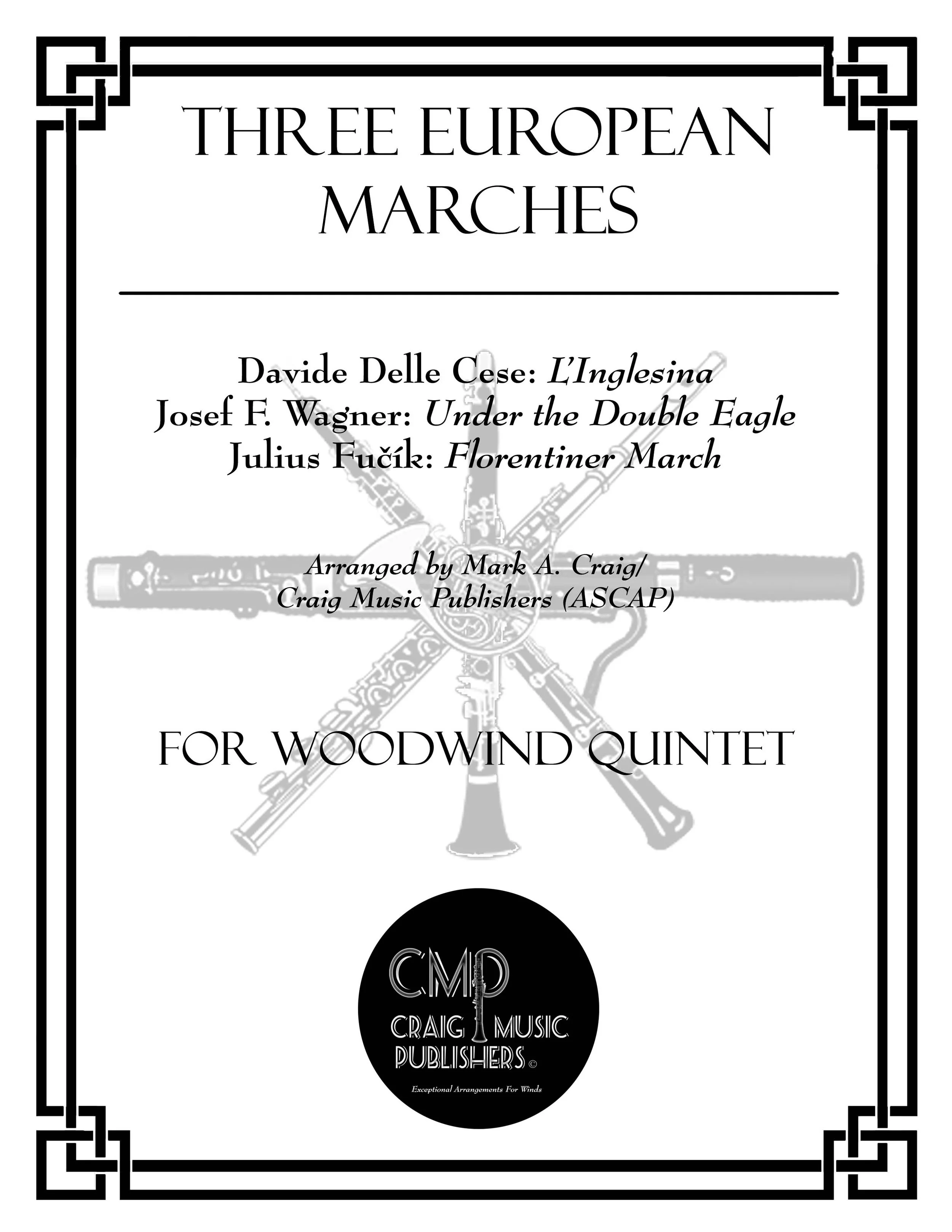
The latest offering from CMP is our Three European Marches, an advanced intermediate woodwind quintet collection which includes the Italian symphonic march, Davide Delle Cese's "L'Inglesina"; the Bohemian symphonic march, Julius Fučík's "Florentiner March"; and the Austrian symphonic march, Josef F. Wagner's "Under the Double Eagle." Although available separately on CMP, you save 40% when you purchase this set of three dynamic marches. These marches from the Romantic Era are not the typical American or Sousa-type marches, but are well known among music students and staples of the concert band repertoire. These short, engaging pieces can break up a long program and give the ears a brief respite from some of the heavier pieces.
All three arrangements are perfect for recitals, contests, competitions, graduations, weddings, military ceremonies, and background-dinner-music gigs. They were written for advanced high school and college ensembles and professional groups. I have included an alternate bass clarinet part in lieu of a missing bassoon. Bring a taste of Europe to your special music events with these three delightful European band classics transformed here into charming woodwind quintets.
Where can I buy digital sheet music collections online arranged for clarinet quartet? Woodwind quartet? Clarinet quintet? Woodwind quintet? Clarinet choir?
Craig Music Publishers!
Support a veteran-owned business and save 40% off the individual price when you purchase these arrangements as a collection, available as digital download PDFs in our Shop, organized by ensemble type.

music trivia questions
First question: Which musical selection from Georges Bizet’s opera Carmen features a fictitious word in the title and text created by the composer to fit his music?
One of the most famous songs from this opera is the “March of the Toreadors,” a triumphant, exuberant, and celebratory piece with heroic brass fanfares and driving percussion. The Spanish word toreador, which refers to a bullfighter, is fictional; it was created by Georges Bizet, by adding a syllable to the known word “torero” to fit his music.
Quick, C. (2016, January 29). 10 facts about Carmen from director Tara Faircloth. 10 Facts About Carmen from Director Tara Faircloth | Arizona Opera. https://azopera.org/blog/10-facts-about-carmen-director-tara-faircloth
Second question: Mozart’s Divertimento in Bb KV 137, was written in 1771-1772, during a trip to which European country?
Wolfgang Amadeus Mozart was traveling with his father Leopold through Italy (their second trip there), and in particular, Milan, in the autumn of 1771 when he began work on the three Divertimenti KV 136-138. These three Divertimenti, written for string quartet, were completed in Salzburg, Austria in 1772, and also known as the “Salzburg Symphonies.”
Seiffert, W.-D. (2021, May 21). Attempt at re-dating Mozart’s three popular “quartet-divertimenti”, K. 136–138. Attempt at re-dating Mozart’s three popular “Quartet-Divertimenti”, K. 136–138. https://blog.henle.de/en/2021/05/10/attempt-at-re-dating-mozarts-three-popular-quartet-divertimenti-k-136-138/
Third question: What was the original intended purpose or use for George F. Handel’s Water Music Suites?
George Friederich Handel wrote his three Water Music Suites in 1717 for King George I. According to Interlude HK:
The Water Music was written to entertain a royal party sailing up the Thames from Whitehall to Chelsea. Rumour has it that Handel was in the Elector’s bad graces because of his extended absences and this work enabled their reconciliation. The music was used not only on the barges as they travelled up and down but also to entertain the court during dinner. There were three suites: one that emphasizes the horns, a second one that emphasizes the trumpets, and a third one, thought to have been the supper music, that has softer instruments. The band was provided by Baron Keilmansegge, who was married to the King’s half-sister, and consisted of 50 musicians. Since this was to be played on the water and the sound needed to be loud, there’s no harpsichord part for this music…The three suites cover 22 movements including all kinds of dances: ‘fast and vivacious Bourées, graceful Minuets in ¾, and 2 Hornpipes that form lively country dances in triple meter. Music in the French style, the English style, and the Italian gave an indication of not only Handel’s skill but also reflected the king’s position.
Buja, M. (2023, March 23). Outdoor Music: Handel’s Water Music. Interlude. https://interlude.hk/outdoor-music-handel-water-music/
Thanks for taking the time to stop by and read my blog. I hope you enjoyed my musings on music. I will be back in two weeks with more anecdotes, memories, and passions for music. In the meantime, you can listen to my arrangement of Handel’s Selections from the Water Music Suites for woodwind quartet by clicking on the MP3 player below. Then click here to purchase it from our Shop. If you have not yet spoken up, tell me in the comment section below which collections you might be interested in seeing on CMP. I’d love to hear about it. Thanks for stopping by. See you in my next blog!
6 March 2026

Handel: Selections from the Water Music Suites - for Woodwind Quartet, cover art
